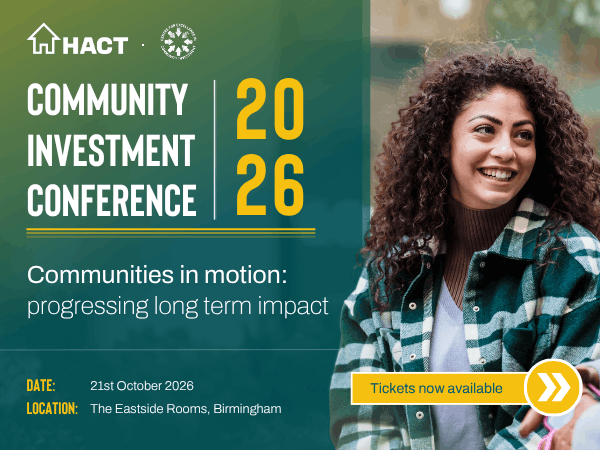
Taking place on the 21st October at the Eastside Rooms in Birmingham, this in-person event is an opportunity for those working in Community Investment to come together, share learning and best practice, and explore new ideas that drive meaningful change in communities.
The tension between measurement and meaning
In a previous role, I was required to report quarterly on employment outcomes. Our targets were clear: hit the numbers. And we did. But the uncomfortable reality was that the best way to meet that target was allowing people to fall out of work and then just restart them into any old job.
On paper, it looked like it was a success. In practice – and for the people concerned – it wasn’t impactful.
Metrics alone are not enough. When it becomes overly prescriptive, imposing rigid rules or burdensome reporting, the act of measuring can become a barrier in itself. Organisations can then end up designing activity around what is easiest to evidence, rather than what communities actually need.
So, how do we recognise when we’re getting it right and when we’re not?
Make measurement responsive, not rigid
At our Social Value Conference earlier this year, I chaired a session at which one of the panellists, Jo Hannan, Head of Foundation at the Fusion21 Foundation, reflected on the role funders can play in supporting organisations to measure proportionately, capture what matters and adapt as learning emerges.
“We work with organisations of different sizes, with different tools, CRM systems and internal capabilities, all of which influences their capacity to measure and monitor,” she said. “What we cannot do and should not do as a funder is impose a certain set of measurement tools to be used, because that doesn’t help level the playing field whatsoever.”
Much of Fusion21’s work supports innovation, through test and learn pilot projects, where outcomes are not always predictable from the outset. Part of the challenge with this is being able to identify and sit with an element of risk, to be willing to accept uncertainty in the beginning so that learning shapes delivery rather than being driven by targets.
“Being flexible, creative, and responsive with measurement is really important,” Jo continued. “What an organisation says they’re going to measure at the start of that programme might look very different in 12, 18 months’ time, so we have to be okay with letting the measurements change and flex over time, as long as it’s meaningful to the delivery of that programme.”
It’s a subtle but important shift, from enforcing measurement to co-designing it. But it also raises a question: if impact can’t always be defined upfront, how do we ensure we are setting ourselves up to achieve it in the first place?
Embedding impact from the start
At the same session, Shelley Hathaway-Batt, Head of Strategic Partnerships at Clarion Futures shared how this can work in practice, bringing examples from a procurement perspective.
“It’s about the fundamentals of how you embed social value through procurement right from start to finish,” she explained.
“That means moving away from counting outputs – how many apprenticeships, how many engagements – and focusing on quality from the outset. At Clarion, this shows up in practical ways: detailed apprenticeship standards, clear expectations around pay and support, and structured partnerships that prioritise outcomes.”
But embedding that approach requires people – specifically, those with deep understanding of communities – to shape decisions, not just at reporting, but at design.
“Are procurement teams necessarily best placed to determine what will be impactful?” Shelley asked. “That’s where community investment professionals come in.”
Her point speaks to a broader shift we’re seeing across the sector: how community investment expertise shapes meaningful social value commitments and investments. Social value can no longer sit in isolation; those leading it must proactively reach out and connect with colleagues working closest to communities, and it must be integrated across teams, into partnerships and into organisational strategy.
Relationships are the real enabler
A culture of openness is necessary to create space for learning, for acknowledging when things haven’t worked and adapting accordingly.
Shifting from a compliance-driven model to a relational one requires persistence and integrating internally can be just as complex as aligning external partners. But relationships don’t just happen. They are built deliberately, through co-design, openness, patience, and understanding.
Jo describes this as “taking people on a bit of a journey,” and enabling both funders and delivery partners to move away from performative reporting towards genuine reflection.
Building systems that work
For me, this ties into the idea that our work increasingly demands systems thinking.
We’re no longer delivering isolated projects. We’re stitching together partnerships across housing associations, VCSEs, suppliers and communities. We’re navigating tensions between targeted investment and wider community impact. And we’re doing so in a context of constrained resources and rising need.
In that environment, the question shifts again, not just how we measure impact, but how we design systems that make impact possible. In practice, this means:
- Prioritising long-term outcomes over short-term outputs, even when systems push us towards simplicity and speed
- Designing flexible, proportionate approaches to measurement, even when that means accepting an element of risk
- Embedding community voice at every stage, and nurturing the cultures that mean we’re able to continue to develop good practice
- Sharing learning openly across the sector, so impact can scale through shared insight
If we’re serious about tackling poverty and creating meaningful change, we need to keep asking ourselves the same question we started with:
Are we just measuring impact? Or are we actually living it?
This is one of the conversations we’ll be taking forward to the HACT Community Investment Conference later this year.
In October, I hope we can come together again and not only learn about what’s working, but challenge ourselves to learn, adapt, and build the kinds of systems – and relationships – that make real change possible.
Because ultimately, social value isn’t just something we report on, it’s something we have to practice every day we come to work.