16 March, 2025

Clarity, measurement and leadership: the priorities shaping your social value in 2026

We recently asked a simple but important question:

What will make the biggest difference to how you measure,
develop and implement your social value work this year
– for the people who experience it?

From the hundreds of responses, one thing is clear: there’s a strong appetite for clarity and consistency. Whether you’re laying foundations, searching for better ways to capture lived experience, or simply starting the conversation within your team, you’re not alone in your thinking. 

In this piece, we explore what these challenges looks like on the ground, and some simple changes you can make to move the conversation forward. 

Top 6 Social Value priorities

1. Establishing a clear approach
and foundations  (30%)


For most organisations, social value activity is already happening. This might be through resident engagement, volunteering programmes, community partnerships or local procurement. Often, however, these activities are siloed, with different teams approaching social value in different ways.

Typically, there’s no shared language and a lack of consistency, which means some of the most meaningful impact goes unmeasured or is never shared beyond the team delivering it. 

Where to start

Building a coherent social value approach takes deliberate effort. The first step is having a clear, organisation-wide definition of what social value means for you, one that connects to your mission and the communities you serve. 

  • It’s likely that you’re already creating impact so start by mapping the activities that benefit people, so nothing is lost. 
  • Choose a consistent framework and measurement approach across the organisation, and create simple processes for collecting evidence throughout the year. 
  • Use independent verification to check your processes, so your key stakeholders have confidence in the impact you’re reporting. 

2. Better measurement that reflects
people’s experiences (25%)


Most organisations already record activities delivered and people reached. But these metrics alone rarely tell the full story of what actually changed for those involved. 

If you track outputs rather than impact, it’s hard to know if your work is truly hitting the mark. And when funders ask not just what you did, but what difference it made, it’s even harder to prove. 

Measure what matters

Many social value measurement tools rely heavily on financial proxy values, but meaningful measurement starts with the people you’re trying to help. 

For example, knowing that 200 people attended a training programme tells you something about reach — but not whether those people felt more confident finding work or whether their situation improved over time. To measure what matters most, we recommend: 

  • Collecting data directly from beneficiaries, not just from service records. 
  • Using validated wellbeing measures that capture subjective experience — how people feel and what’s changed for them. 
  • Tracking change over time, not just point-in-time snapshots. 

3. Whole-organisation commitment
to social value (16%)


Embedding social value across your whole organisation can be difficult. 

It requires cultural change, clear communication, and the kind of sustained commitment that competes with other organisational priorities. 

Ownership and Accountability

Many organisations address this by appointing social value champions or cross-departmental working groups to help keep the work visible beyond a single team. We would also recommend:

  • A shared definition of social value that connects to your mission, and regular communication that makes it visible and celebrated, not just reported. 
  • Social value embedded into job descriptions and team objectives. 
  • Support from the top is key – and not just for the social value that affects the balance sheet; it must be about driving impact at a strategic level. 

4. Using social value
to drive decisions and investment (10%)


Social value is often used retrospectively to describe what’s already happened rather than something that shapes decisions. 

When it’s part of the conversation from the start, social value shifts from being a reporting metric to a tool that can help you understand where you can create the most meaningful change. 

Applying in practice  

  • Use social value data to compare the relative impact of different programmes or interventions and present it alongside financial data in reporting. 
  • Build social value considerations into procurement criteria, partnership agreements, and new service design. 
  • Use community wellbeing data to identify where investment is most needed. 

The role of wellbeing data

If your measurement approach only assigns activities a broad financial value, you can’t compare the relative impact of different interventions on the people who matter most. You end up with numbers, but not insights. 

Measuring changes in individual wellbeing — rather than just recording activities — can provide a much richer picture. This is the principle behind HACT’s wellbeing methodology, which focuses on understanding how people’s lives change as a result of services or interventions. Evidence like this can support board discussions, inform investment decisions, and strengthen the case for scaling programmes that genuinely improve people’s lives.

Find out more about our wellbeing approach

Get in touch

5. Stronger leadership accountability from senior leaders (5%)

Leadership accountability isn’t just about receiving reports. It’s about asking questions and being willing to make decisions based on what the data shows.  

Practical steps include building social value reporting into board cycles and ensuring senior leaders can speak fluently about your social value strategy, not just delegate. 

6. Independent validation or external assurance (3%)

External assurance is a mark of genuine confidence in your approach. It demonstrates your impact to others and signals to funders, commissioners and communities that your social value claims are grounded in credible evidence. 

Before seeking external validation, it helps to ensure data collection is consistent, methodologies are clearly documented, and reporting is transparent. 

You aren’t alone — and that matters

Many of us are facing the same challenges, which is proof of a wider shift happening across the sector. Having questions doesn’t mean you’re behind in your work – it shows you’re taking social value seriously. 

Change starts with a conversation

At HACT, we spend a lot of time speaking with organisations navigating exactly these questions. 

If any of the challenges in this piece resonate with where you are right now, or you’d like further support with implementing our suggestions, we’d love to talk. 

Book a chat with one of our social value experts

Get in touch

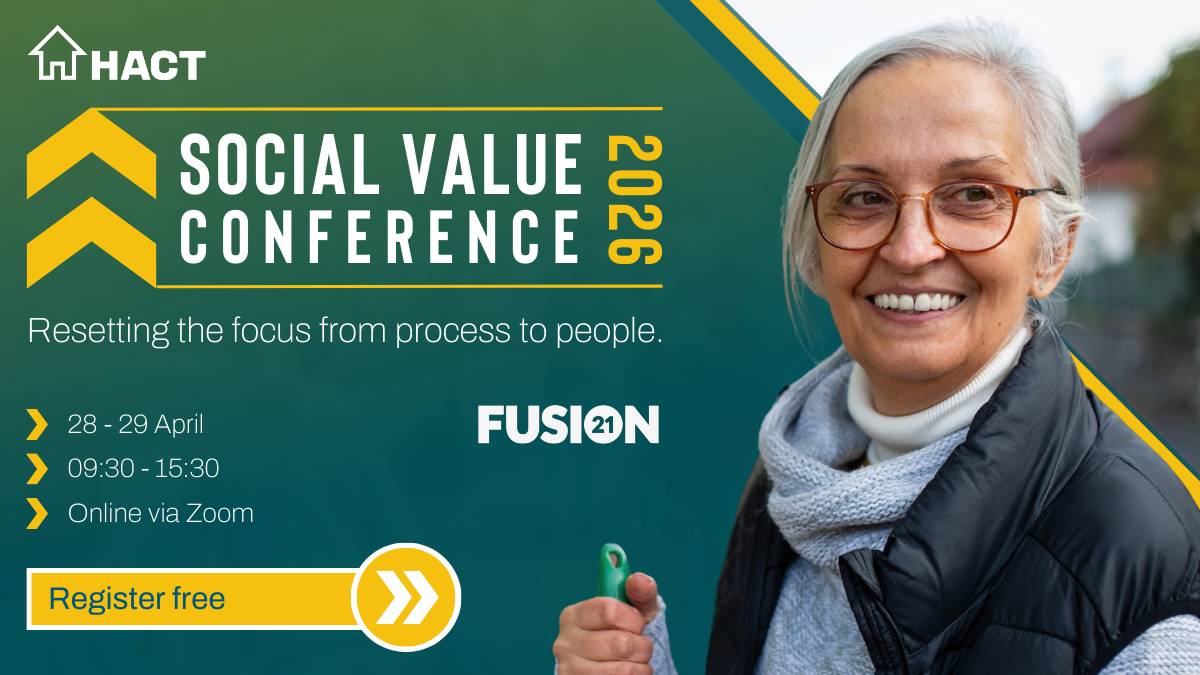
Social Value Conference 2026

Tuesday 28 and Wednesday 29 April

Our annual Social Value Conference is a free, two day, online event bringing together practitioners, leaders, and experts to challenge, inform and drive the agenda for Social Value.

There are multiple sessions across two days, and we encourage those who are at any stage of their social value journey to dip in and out over the event to hear discussions and connect with others involved in social value work.

Register free now