8 May, 2026

An inconvenient truth: Who pays for social value?


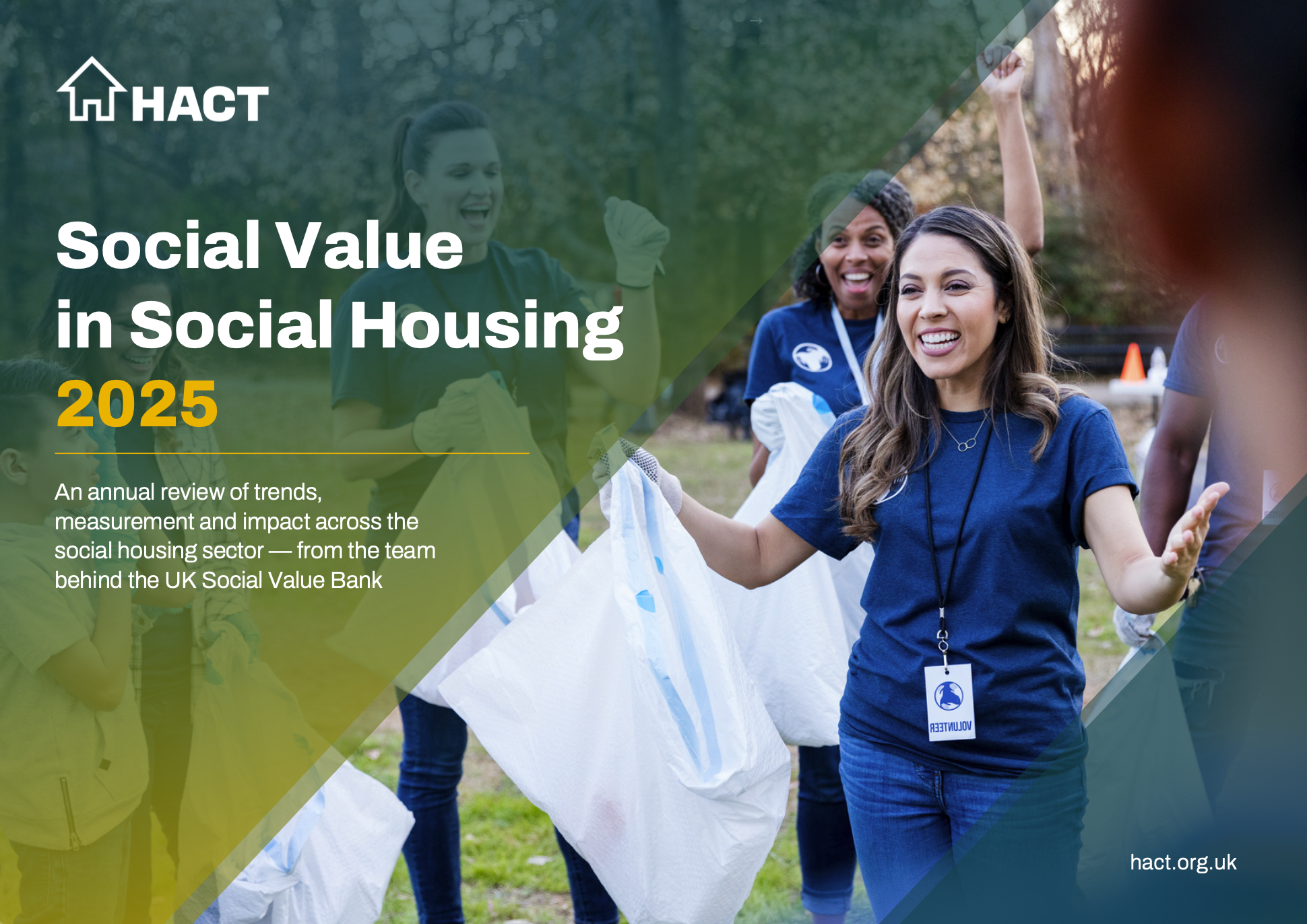
Taken from the report ‘Social Value in Social Housing 2025 – an annual review of trends, measurement and impact across the social housing sector.’

Andrew van Doorn OBE, Chief Executive, HACT and Rebecca Rees, Partner and Head of Public Procurement, Trowers & Hamlins

Read the full report

Social Value in Social Housing 2025

An annual review of trends, measurement and impact across the social housing sector – from the team behind the UK Social Value Bank.

” A pound of public sector money spent through procurement without achieving social value is a pound wasted” (paraphrased)

Lord Agnew

former Minister of State at the Cabinet Office and HM Treasury

It would be a brave soul indeed who argued against public sector buyers seeking to achieve social value impact through their spending decisions.

Social value (not defined in the procurement sense but a term that refers to benefits created through public-sector contracts that extend beyond the core deliverables of that contract such as training and skills, local jobs, environmental improvements, community investment, or supporting SMEs) is very much the current “poster girl” of the procurement world. It highlights how public procurement can be used to secure additional value for the public sector purse.

Over recent years, we have seen social value become both a creative and impactful space for public procurement. Public sector organisations and housing associations have been asking for and securing, ever more expansive programmes of social value, involving complex multi-year delivery and deep engagement with communities. In many ways, social value has become the differentiator that demonstrates the contractor’s commitment to driving economic, social and environmental outcomes.

Conversations, however, get interesting when you ask buyers and bidders who pays for the social value outcomes. With the increasing scale and complexity of social value programmes being put on the table, and the growing workforce of social value managers, co-ordinators and specialists now evident across the contractor landscape, this question becomes even more important. And it is this disconnect between what the key players of a public procurement process think about this that we need to explore.

Who pays?

Many public sector buyers strenuously insist that they do not pay for social value, that it is delivered “for free” (out of a bidder’s profit margin?) and is a cost to the bidder that it must swallow to win the contract. Another way of putting it is, “public sector buyer sets the price of entry; the bidder pays it and the community (and/or the wider society) benefits”.

Too often concepts of additionality get confused or conflated when the question of resourcing is raised. The costs of delivering social value are certainly not additional to either the bidder, nor the buyer. Bidders can often be coy about who bears the cost, arguably gaslighted into this position by politicians and practitioners who insist social value is delivered for free. Nevertheless, research has shown that the costs of social value are built into bids through a combination of pricing methods, commercial strategy, and risk appetite. In terms of pricing methods, these include:

Indirect

Through the central office overhead or margin priced on every bid by the bidder regardless of the social value ask of the project (this overhead cost will also include their CSR budget).

Direct

As a specific project cost, often spread across the different line items requested rather than separated out on its own.

In terms of commercial strategy, bidders will decide on which of the two pricing methods they will adopt and what to recharge the buyer. It may be that they seek to minimise additional cost for a bid by either leveraging what they are doing elsewhere for other buyers or by working with charities and intermediaries to share the cost of initiatives.

Turning to risk appetite, it may be that bidders do not price social value outcomes into a bid directly and accept the risk that it may have to absorb the cost of the social value delivery. This absorption will rarely hit their profit margin though and is not wholly altruistic. Instead, it will usually be assuming that the buyer will not demand delivery of the social value promises, either through the lack of (1) contract management, or (2) service delivery visibility of the offer made at bid stage.

Whichever way the cost is absorbed, there is still a cost and it is foolish to believe that price isn’t affected by both the social value ask and how it is delivered.

“Whichever way the cost is absorbed, there is still a cost
and it is foolish to believe that price isn’t affected by both
the social value ask and how it is delivered.”

Dr Rebecca Ress

Rebecca Rees Partner and Head of Public Procurement, Trowers & Hamlins

Is it the fault of the procurement process?

It is often the design of the competition documents that maintains the fiction. Social value offers are usually evaluated only on a benefit basis: e.g. what is going to be delivered and what is the attributed value to that social value offer. Most competitions avoid acknowledging a separate head of cost for the social value requirements, requiring instead that the bidders disguise associated costs within the rates requested.

Given this, UK bidding practices, encouraged by PPN 002 and the central government Social Value Model, focus on social value commitments, method statements and delivery models and KPIs for measurement. Cost remains invisible.

Does it matter?

We would argue that it matters enormously. The public sector’s persistent reluctance to acknowledge that social value has a real cost to the buyer, rather than being absorbed by the bidder, leads to the wrong conversations taking place at the wrong levels. From the outset, this approach embeds a series of risks and poor practices that too often go unexamined and unmanaged.
Ambitious social value requirements are frequently specified without sufficient regard to affordability. Buyers rarely test whether their social value “ask” is realistic, whether programmes have been properly scoped, or whether costs have been credibly modelled to deliver the outcomes being promised.

This creates an inherent fragility in delivery that only becomes apparent once contracts are underway. The current approach also distorts competition. Larger and more sophisticated bidders are routinely advantaged over smaller organisations and new entrants, not because they are better at delivering the core purpose of the contract, but because they are better able to absorb, spread, or strategically price social value costs across wider portfolios. In effect, social value becomes a proxy for balance sheet strength rather than a genuine measure of added public benefit.

Over time, these costs are normalised into the market, subtly but materially shifting perceptions of what “value for money” means. While the Procurement Act 2023, like its predecessors,
recognises that the Most Advantageous Tender is not necessarily the cheapest, there is still limited willingness to confront the reality that social value requirements can and do increase prices across the public sector. This tension remains largely unspoken.

Perhaps most concerning, the current environment discourages meaningful debate about whether procurement is always the right mechanism for delivering social value at all. There is a long and well-established history behind the Social Value Act 2012, but that should not exempt its practical application from scrutiny.

Some of the questions we need to be asking:

There is also a broader strategic question about whether social value through procurement is beginning to displace more deliberate and effective approaches to social regeneration. We risk sidelining place-based, long-term programmes of social capital development, grounded in decades of research and evaluation, in favour of fragmented, contract-led interventions that are easier to specify but harder to sustain.

Ultimately, we must be clear about what we are trying to achieve. Is social value intended as a means of justifying public expenditure with the private sector? Is outsourcing more palatable if
private companies accept lower margins and redirect the foregone profit into social value activity? If so, we should be explicit about that choice, rather than allowing it to sit implicitly within procurement processes.

Please do not misunderstand us. We are, and always have been, strong advocates of social value. We firmly believe that public expenditure should be used to improve social, economic and environmental outcomes. Our concern is simpler, but more fundamental: without a clear and honest conversation about cost, we undermine our ability to make informed choices about how public money is spent and, ultimately, how the best outcomes are delivered.

What next?

Lord Agnew has previously suggested that “a pound of public sector money spent through procurement without achieving social value is a pound wasted” (paraphrased). If that is the prevailing political lens through which social value is viewed, then we must also be willing to engage with the consequences of that position. Acknowledging that social value is not cost‑neutral, and that it is not, in reality, “paid for by the bidder” but by the public sector, inevitably complicates the conversation. That complication should not be avoided.

If public bodies and housing associations are paying contractors to deliver social value, we should ask whether procurement is always the best approach, or whether some outcomes may be delivered more effectively, efficiently, or strategically through direct delivery or specialist partners. We should also be more honest about how much we are willing to pay to outsource social value activity and whether we are genuinely achieving value for money from those arrangements once overheads, transaction costs and delivery risk are taken into account.

At a more practical level, there needs to be greater discipline and transparency about proportionality. What constitutes a reasonable and appropriate social value requirement for a particular contract, sector or market? How do we ensure that social value expectations are clearly costed, affordable, and aligned with delivery capability, rather than aspirational additions that create hidden pressure in price, risk and performance?

Answering these questions will require a more mature conversation about who pays for social value, how much it costs, and what trade‑offs are being made. That conversation may be uncomfortable, but without it we risk undermining the very outcomes social value policy is intended to achieve.

Greater honesty and transparency are not a threat to social value; they are a prerequisite for doing it well.

Get in touch

Start the conversation with the HACT team about taking the next step on your social value journey.

Contact Lara